AI Semiconductor: The Engine Driving Future Intelligence
As the wave of artificial intelligence sweeps the globe, AI semiconductors have become the most critical infrastructure in the tech industry. From massive computations in data centers to edge inference on smartphones, from real-time decision-making in autonomous driving to precise analysis of medical images, everything relies on high-performance, low-power AI chips. These processors, optimized for deep learning and neural networks, are leading humanity into an unprecedented era of intelligence. However, as Moore's Law gradually slows and geopolitical risks heat up, the development of AI semiconductors faces dual challenges in technology and market.
1. Deep Integration of Technology Breakthroughs and Application Scenarios
The core of AI semiconductors lies in architecture design that must closely match algorithms. Traditional central processing units (CPUs) cannot meet the demands of large-scale parallel computing due to their general-purpose nature, making graphics processing units (GPUs) the mainstream choice for deep learning training. However, as the parameter count of Transformer models jumps from billions to hundreds of billions, specialized AI accelerators like Google's TPU, Cerebras' wafer-scale chip, and emerging neural processing units (NPUs) are gradually coming to the forefront.
These chips not only pursue computing speed but also emphasize energy efficiency. For example, in edge devices, AI chips must complete real-time inference with extremely low power consumption, driving the development of processing-in-memory technology. Meanwhile, exploration of photonic chips and quantum computing, although still in experimental stages, offers infinite possibilities for breaking physical limits. The diversification of application scenarios, from cloud training to terminal execution, is driving AI semiconductors toward specialization and heterogeneity.
2. Market Landscape and Competitive Dynamics
Currently, the global AI semiconductor market is dominated by NVIDIA, whose GPU, with its complete software ecosystem (CUDA), holds over 80% of the data center training market share. However, AMD is closely following with its Instinct series and open-source ROCm platform, while Intel is trying to make a comeback through Habana Labs and Gaudi processors. More importantly, cloud service giants like Google, Amazon, and Microsoft are developing their own chips, aiming to reduce dependence on external suppliers.
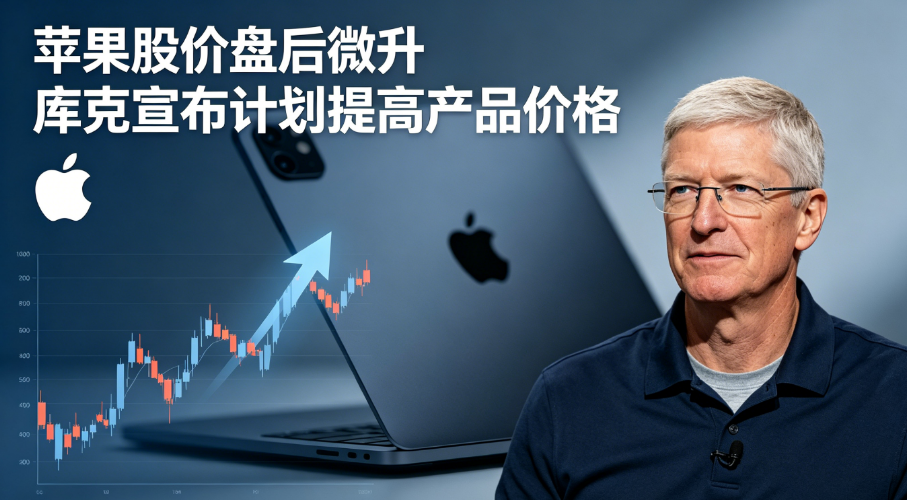
The image above shows Apple's stock edging up after hours following Cook's announcement of product price increases, reflecting market confidence in tech giants' ability to pass on AI chip costs. In fact, all large tech companies are ramping up AI semiconductor investments: Apple's M-series chips integrate a Neural Engine, Qualcomm has launched the Snapdragon X Elite to strengthen on-device AI, and the competition between Samsung and TSMC in advanced processes has become intense. Geopolitical factors are also reshaping the supply chain landscape, with US-China tech decoupling prompting countries to promote local chip production, making AI semiconductors a strategic material.
3. A Crossroads of Challenges and Opportunities
Despite the bright prospects, AI semiconductors face severe challenges. First, high costs: R&D and fab construction for advanced processes (e.g., 3nm, 2nm) can cost tens of billions of dollars, affordable only to a few players. Second, energy efficiency: data center power consumption has become a major source of global carbon emissions, and reducing energy consumption without compromising performance is a common industry challenge. Third, software ecosystem: hardware needs efficient compilers and libraries to unleash performance, and NVIDIA's CUDA advantage is difficult to shake in the short term.
However, opportunities are equally significant. As generative AI expands from text to images, video, and 3D content, demand for computing power grows exponentially. Furthermore, penetration in vertical fields such as autonomous driving, smart manufacturing, and precision medicine will open new blue oceans for specialized AI chips. The rise of the open-source instruction set architecture RISC-V has also lowered the barrier to chip design, allowing startups to participate in the competition.
4. Future Outlook: Evolution from Chips to Systems
The next stage of AI semiconductors will no longer be a competition of individual chip performance but a battle of system-level integration. Chiplet technology allows chip modules from different processes to be connected through advanced packaging, enabling flexible scaling of computing power; optical interconnect technology may break bandwidth bottlenecks. Meanwhile, attention is turning to solutions for the "memory wall" and "power wall," such as analog computing and event-driven architectures. Experts predict that by 2030, the AI semiconductor market size will exceed $100 billion, driving structural transformation across the entire semiconductor industry.
Conclusion
AI semiconductors are not just catalysts for technological innovation; they are the infrastructure of the digital economy era. From chip design to manufacturing, from algorithms to applications, every link in the industry chain is accelerating. As AI penetrates every corner of human life, semiconductors will evolve from "computing tools" to "perception and decision-making centers." For companies and countries, mastering the dominance of AI semiconductors means holding the key to the future intelligent world. On this track, only continuous innovation, collaboration, and prudent planning can ensure a winning position in fierce global competition.