
AI Semiconductor: Interplay of Tech Revolution and Market Fluctuations
Keywords: AI Semiconductor, Artificial Intelligence, Chip Design, Market Fluctuations, Supply Chain Challenges
Introduction
The explosive growth of artificial intelligence (AI) is reshaping the global semiconductor industry at an unprecedented pace. From ChatGPT to generative AI models, from autonomous driving to edge computing, AI chips have become the "new oil" of the digital economy. However, this technological revolution is not without bumps—recent sharp fluctuations in the semiconductor equipment sector, with some AI-related stocks dropping over 10% in a single day, reveal the market fragility hidden behind this high-growth field. This article analyzes the opportunities and challenges of the AI semiconductor industry from three perspectives: technology evolution, market turmoil, and future strategies.
1. Technological Frontiers of AI Semiconductors: From GPUs to Custom Chips
At the core of AI computing is the parallel processing capability for massive data. Traditional central processing units (CPUs) struggle to meet the immense computing demands of deep learning models, so graphics processing units (GPUs), with their efficient parallel architecture, became the preferred hardware for AI training. NVIDIA's A100, H100, and the latest B200 series essentially dominate the high-end AI training market, with performance improvements outpacing even the traditional pace of Moore's Law.
However, as AI models grow exponentially in size (e.g., GPT-4's parameter count exceeds 1.8 trillion), the energy and cost bottlenecks of general-purpose GPUs become more apparent. The industry is shifting toward application-specific integrated circuits (ASICs) and field-programmable gate arrays (FPGAs). Google's TPU, Tesla's Dojo chip, and many startups' AI inference chips demonstrate the tremendous potential of hardware optimization for specific computing scenarios. Additionally, advanced packaging technologies (e.g., Chiplet, 3D stacking) and high-bandwidth memory (HBM) integration are critical paths to overcoming the memory wall.
2. Market Fluctuations and Supply Chain Challenges: Supply-Demand Imbalance and Geopolitics
Despite the bright prospects of AI semiconductor technology, its market performance is fraught with uncertainty. The recent collective downturn in the semiconductor equipment sector is the result of multiple overlapping factors.
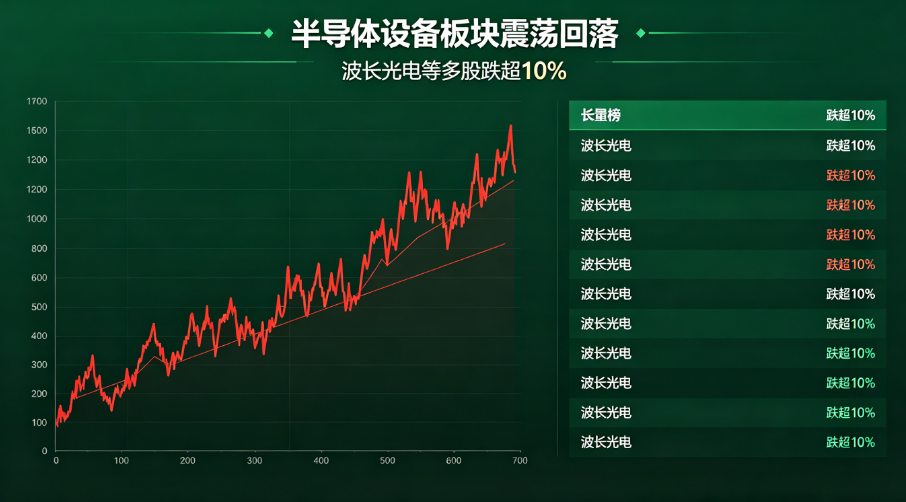
The image above shows that several semiconductor equipment suppliers, including Wavelight Photonics, saw their stock prices fall more than 10% in a single day. This pullback stems from three main pressures:
- Supply-Demand Cycle Shift: Although AI chip demand is strong, capital expenditures by foundries (e.g., TSMC) are at historical highs. Some analysts worry about overcapacity in mature processes by the second half of 2025, leading to order cuts for equipment.
- Escalating US Export Controls: The US has been tightening export restrictions on advanced semiconductor equipment and AI chips to China, directly impacting revenue expectations for equipment makers like Applied Materials and Lam Research. Geopolitical risks force supply chains to accelerate "de-risking," but also increase global operating costs.
- Valuation Bubble Concerns: AI concept stocks experienced astonishing gains in 2023–2024, with generally high price-to-earnings ratios. Once the market questions AI's monetization capability, the capital flight can trigger drastic chain reactions. For example, some cloud service providers have begun developing their own AI chips, potentially reducing reliance on traditional GPU suppliers and triggering earnings estimate adjustments.
3. Future Outlook: Continuous Innovation and Strategic Adjustments
Facing an increasingly volatile market environment, the AI semiconductor industry needs to adjust strategies across three dimensions: technology, business models, and supply chain resilience.
From a technology perspective, heterogeneous integration and advanced process advancement remain core. The mass production challenges of nodes below 3nm, capacity bottlenecks for extreme ultraviolet (EUV) equipment, and commercialization of new memories (e.g., MRAM, HBM4) will determine the competitive landscape of next-generation AI chips. Additionally, emerging disruptive technologies like quantum computing and photonic computing lay the groundwork for long-term development.
From a business model perspective, shifting from simply selling chips to offering "Compute as a Service" (CaaS) is becoming a trend. For example, NVIDIA's DGX Cloud and AWS's Trainium rental services reduce customers' upfront costs while providing stable cash flow for suppliers. Such models help smooth out cyclical fluctuations in hardware sales.
From a supply chain perspective, diversified layouts and localized production are inevitable. TSMC's fab plans in the US, Japan, and Germany, as well as Intel's return to foundry services, are attempts to spread geopolitical risk. Equipment makers also need to collaborate more closely with end customers to stay close to market demand and avoid inventory buildup.
Conclusion
AI semiconductors are at a watershed where technological innovation and market turbulence coexist. In the short term, fluctuations in the equipment sector and sharp corrections in individual stocks reflect investors' sensitivity to valuation and geopolitical risks; but in the long term, the rigid demand for AI computing power remains unchanged, and application scenarios such as smart healthcare, autonomous driving, and Industry 4.0 are still rapidly landing. Industry participants must find a balance between technological frenzy and rational management—embracing the marginal benefits of Moore's Law while guarding against business cycle and policy uncertainties. Only companies with deep technical accumulation and flexible strategic adjustments can stand out in this AI semiconductor competition.