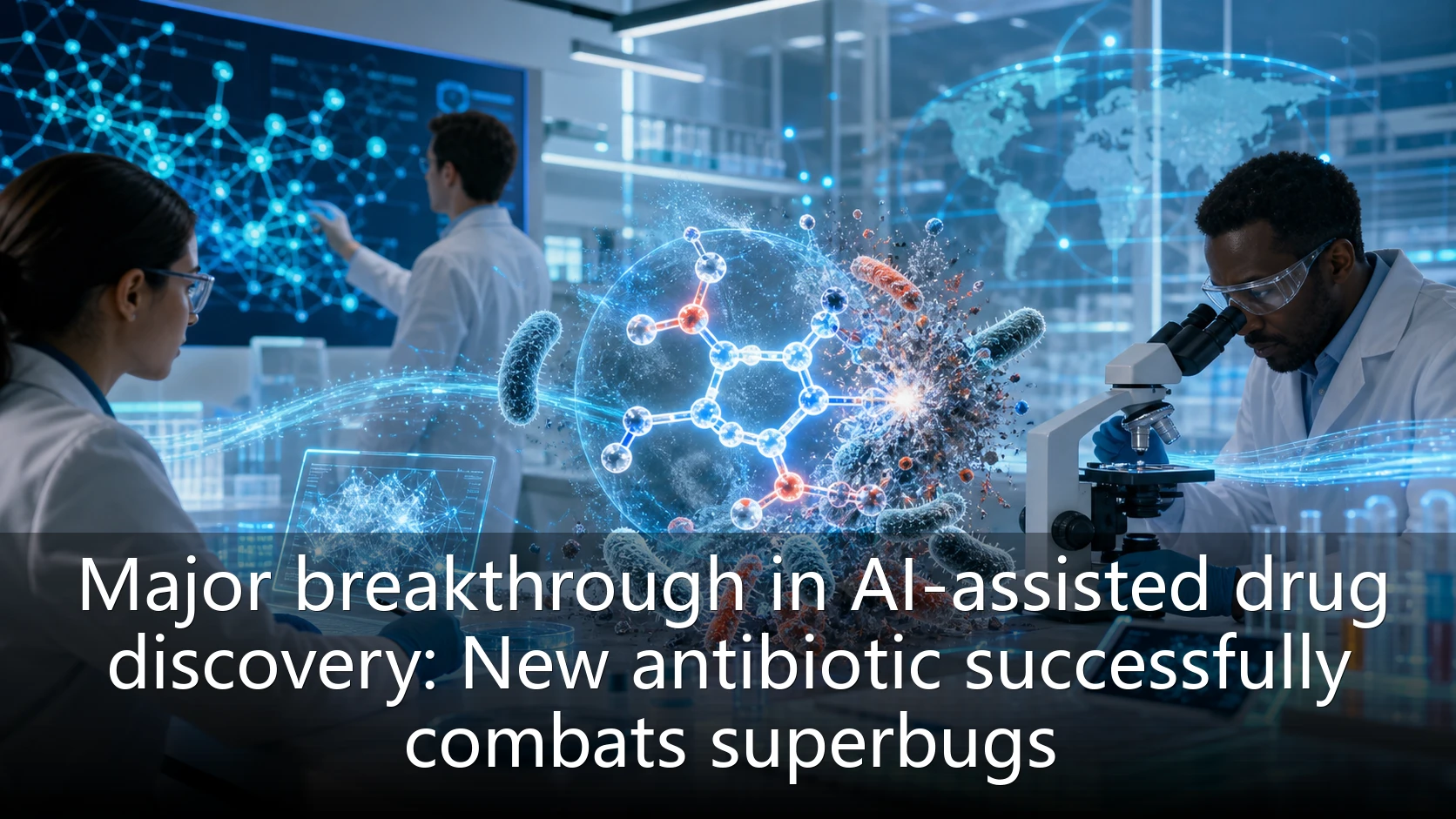
On July 28, 2026, the Massachusetts Institute of Technology (MIT) and AI lab DeepMind jointly announced the discovery of a novel antibiotic "Aureomycin-X" using a generative AI model, which successfully inhibited multiple "superbugs" including Acinetobacter baumannii and Pseudomonas aeruginosa in animal models. The research was published in Nature Biotechnology and is considered a major milestone in AI-driven drug development.
From Molecular Ocean to Precision Strike: How AI Screens Drug Candidates
Traditional antibiotic discovery relies on soil microorganism screening or random testing of chemical libraries, which is time-consuming with low success rates. The research team developed the "PharmaGAN" model, a deep learning framework based on generative adversarial networks. Researchers first trained the model using known antibiotic structures and three-dimensional data of bacterial protein targets, allowing AI to learn the chemical space features of "effective antimicrobial molecules." The model then automatically generated over 100 million novel molecular structures and simulated their binding ability to bacterial cell wall synthesis enzymes through virtual screening.
After three rounds of iteration, the team ultimately selected 23 high-potential molecules, synthesized them, and conducted in vitro experiments. Among them, "Aureomycin-X" stood out: it not only showed strong efficacy against Gram-negative bacteria (a more difficult-to-treat category) but also exhibited very low toxicity in human liver cell tests. Further molecular mechanism analysis revealed that the drug targets the bacterial lipopolysaccharide transport system—a target previously unexploited by antibiotics, meaning bacteria are unlikely to develop resistance in the short term.
Industry Impact: Pharmaceutical Giants Accelerate AI Platform Deployment
Following the announcement, stock prices of several international pharmaceutical companies rose. Roche and Pfizer immediately announced expanded cooperation agreements with AI companies. According to a report by market research firm IDC, the global AI drug discovery market reached $8.5 billion in 2026 and is projected to exceed $30 billion by 2030, with a compound annual growth rate of over 28%.
"In the past, it took us 10 years and $1 billion to bring an antibiotic to market. Now AI can shorten the candidate molecule discovery phase to a few months, reducing costs by over 90%," said James Collins, MIT computational biology professor and co-author of the paper, at a press conference. He added that the team has begun pre-IND communication with the US FDA and expects to launch Phase I clinical trials as early as 2027.
Superbug Crisis Drives Technological Innovation
The World Health Organization (WHO) updated its "Priority Pathogens List" in 2025, noting that deaths due to antibiotic resistance already exceed 1.2 million annually, and could rise to 10 million by 2050 without action. However, only two novel-mechanism antibiotics have been approved globally in the past 30 years, with pharmaceutical companies withdrawing due to low economic returns. AI intervention is seen as key to breaking the deadlock.
DeepMind CEO Demis Hassabis stated that the source code of PharmaGAN will be open-sourced within six months, free for academic institutions and non-profit organizations. This move is expected to encourage more small laboratories to participate in antimicrobial drug discovery, forming a global collaboration network.
Challenges and Concerns: Data Bias and Clinical Translation Bottlenecks
Despite promising prospects, AI drug development still faces many challenges. First, training data mainly comes from public databases dominated by genetic and disease data from Western populations, which may cause AI to perform poorly on bacterial subtypes specific to Asian and African populations. Second, although AI-designed molecules perform well in computer simulations and animal experiments, the human physiological environment is much more complex, resulting in low clinical translation rates. Industry statistics show that among AI-discovered drug candidates entering clinical stages, the final approval rate is about 8%, higher than the 2% of traditional methods, but there is still much room for improvement.
Regulation and Ethics: How to Approve AI-Generated Drugs?
Regulatory agencies worldwide are actively responding. The US FDA released the "AI-Assisted Drug Development Guidance" in early 2026, explicitly requiring that AI-generated molecules provide "explainable chemical space reasoning pathways." The European Medicines Agency is building an "AI validation sandbox" for companies to test model reliability in a controlled environment. The industry calls for global unified AI pharmaceutical standards to accelerate review while ensuring safety.
Investment Insights: Opportunities in AI + Healthcare
For Chinese investors in Singapore, Malaysia, and Thailand, the AI drug development track is showing three major trends: First, joint ventures between large tech companies (e.g., Google, Microsoft) and pharmaceutical companies continue to emerge; second, AI startups focused on protein structure prediction and molecular generation are receiving massive funding; third, traditional CROs (contract research organizations) are beginning to offer AI clinical design services. StashAway Smart Investing analysis suggests that the venture capital return cycle in this field is about 5-8 years, suitable for long-term investors to participate through thematic ETFs or private equity funds.
On the personal finance level, investors should diversify across industries—antibiotic discovery is just one part of AI healthcare applications; others like AI for early cancer diagnosis and gene editing AI are also worth attention. Regular investment in index funds covering AI + healthcare is one way to participate steadily in the AI wave.
Conclusion
The birth of Aureomycin-X proves that AI is no longer just a tool but a co-creator in drug discovery. By precisely mining candidate drugs from vast molecular spaces, AI demonstrates chemical insight beyond human intuition. With continuous iterations of generative AI and reinforcement learning, we may witness an "antibiotic renaissance" in the next decade—not only a technological victory but also a critical turning point in humanity's war against antimicrobial resistance.