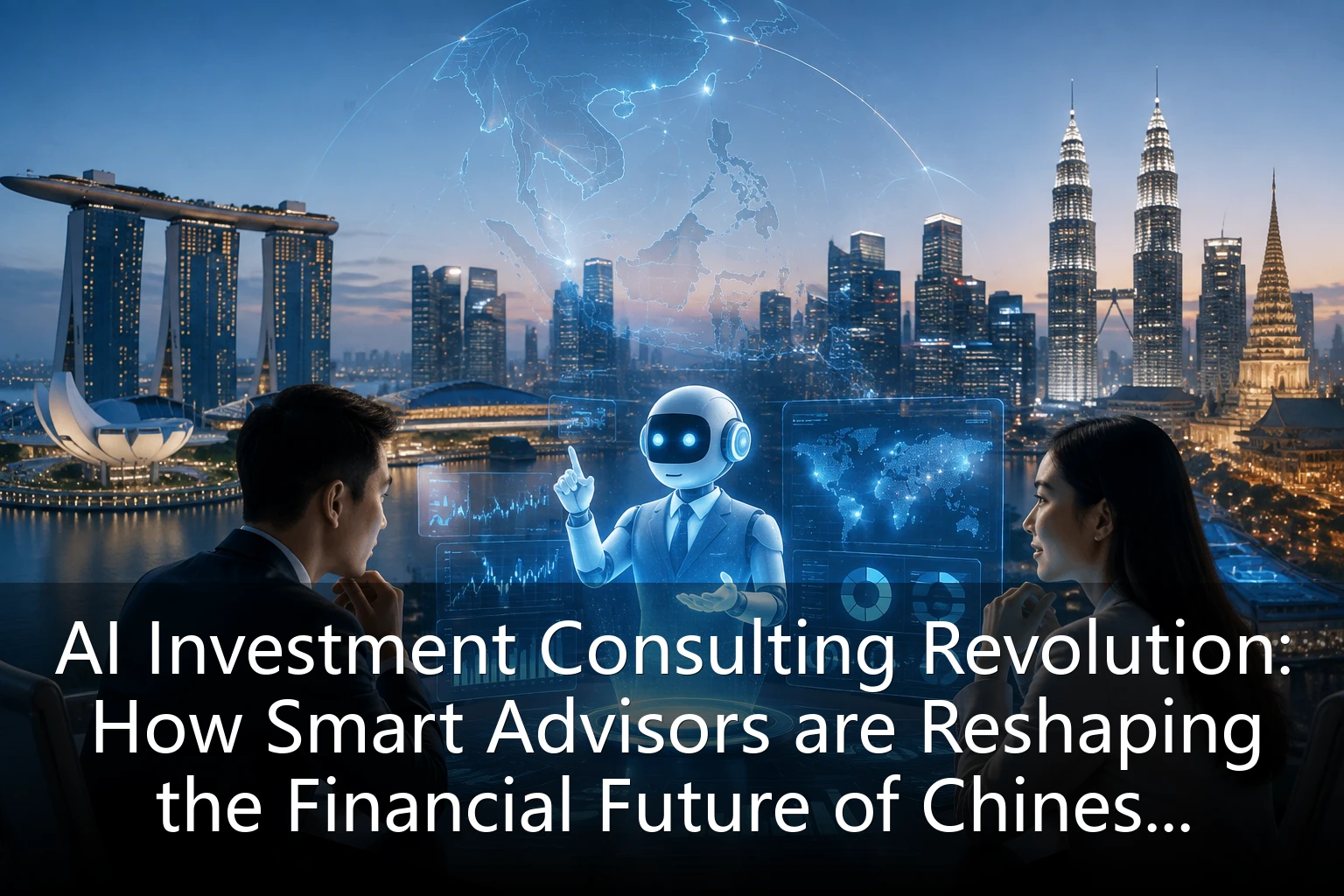
AI Investment Consulting Revolution: How Smart Advisors are Reshaping the Financial Future of Chinese Communities in Singapore, Malaysia, and Thailand
\nWith the rapid advancement of artificial intelligence technology, the global financial industry is undergoing unprecedented transformation. In Singapore, Malaysia, and Thailand—three Southeast Asian countries with significant Chinese populations—AI investment consulting is rapidly reshaping traditional financial models at an astonishing pace. This article will delve into how this revolutionary change affects investment decisions among Chinese communities in these countries, and how smart robo-advisor platforms leverage technological innovation to provide users with more precise and efficient financial services.
\n\nAI Investment Consulting: From Concept to Reality
\nThe application of artificial intelligence in investment consulting has evolved from concept to maturity. According to the latest market research data, the market size for AI-driven investment advisors in Southeast Asia is expected to grow by 300% within the next five years, reaching a scale of tens of billions of dollars. This growth is primarily driven by three key factors: first, the exponential improvement in computing power, enabling complex algorithms to process massive amounts of data in milliseconds; second, the maturation of big data technology, allowing AI systems to integrate real-time information from global markets; and finally, breakthroughs in machine learning algorithms, enabling investment models to continuously self-optimize and improve prediction accuracy.
\n\nCompared to traditional investment advisors, AI investment consulting offers significant advantages. Traditional advisors typically rely on limited historical data and experience-based judgments, while AI systems can process millions of data points simultaneously, identifying market patterns that humans might miss. More importantly, AI advisors are not affected by emotional fluctuations and can maintain rational analysis at all times, which is particularly valuable during market volatility.
\n\nThe Singapore-Malaysia-Thailand Market: Fertile Ground for AI Investment Consulting
\nSingapore, Malaysia, and Thailand, as the most economically developed countries in Southeast Asia, have large and growing populations of Chinese investors. These investors typically have cross-border financial needs, are familiar with digital technology, and have a high acceptance of innovative financial products, creating an ideal environment for the development of AI investment consulting.
\n\nIn Singapore, the financial technology regulatory sandbox policy provides a safe testing environment for the innovative development of AI investment advisors. The digital asset framework launched by the Malaysian Securities Commission provides legal protection for AI-driven portfolio management. Thailand is actively attracting AI investment consulting firms through its fintech incubation programs. These regulatory innovations have laid a solid foundation for the rapid development of AI investment consulting in the Singapore-Malaysia-Thailand region.
\n\nCore Technological Breakthroughs in AI Investment Consulting
\nModern AI investment consulting systems integrate multiple cutting-edge technologies to build a smart financial ecosystem. First is the breakthrough in Natural Language Processing (NLP) technology, enabling AI systems to understand complex investment needs and risk preferences of clients. By analyzing client language expressions, AI advisors can construct precise investor profiles, providing a foundation for personalized asset allocation.
\n\nSecond is the application of reinforcement learning algorithms. Unlike traditional machine learning, reinforcement learning allows AI systems to continuously optimize investment strategies through interaction with the market environment. In practical applications, this means AI advisors can dynamically adjust asset allocation as market conditions change, improving the risk-adjusted returns of investment portfolios.
\n\nThird is cross-market data integration technology. Modern AI investment advisors can simultaneously analyze data from various asset classes such as stocks, bonds, foreign exchange, and commodities, identifying correlations between different markets and constructing more diversified investment portfolios. For Chinese investors in the Singapore-Malaysia-Thailand region, this cross-market analysis capability is particularly important as their investment portfolios typically involve assets in multiple jurisdictions.
\n\nPractical Application Cases of AI Investment Consulting
\nIn the Singapore-Malaysia-Thailand region, several leading robo-advisor platforms have launched mature AI investment consulting services. These services not only provide traditional asset allocation advice but also customize solutions based on specific client needs.
\n\nFor example, addressing the common cross-border inheritance needs of Chinese communities in these countries, AI advisors can design comprehensive solutions including family trusts, cross-border insurance, and education funds. For families with immigration plans, AI systems can optimize asset structures based on the tax policies and investment environments of target countries, maximizing after-tax returns.
\n\nAnother important application scenario is ESG (Environmental, Social, and Governance) investing. With the growing popularity of sustainability concepts, an increasing number of Chinese investors want to incorporate ESG factors into their investment decisions. AI systems can analyze ESG performance data from hundreds of companies, screening out investment options that align with investors' values, solving the complex screening challenges that traditional advisors struggle to handle.
\n\nChallenges Facing AI Investment Consulting
\nDespite its rapid development, AI investment consulting faces multiple challenges. First is the issue of data quality. The performance of AI systems largely depends on the quality of training data, and the unique characteristics of financial markets make it difficult to obtain high-quality, representative data.
\n\nSecond is the issue of algorithm transparency. Many advanced AI models function like "black boxes," making their decision processes difficult to explain. For investment, a field requiring high levels of trust, lack of transparency may reduce client acceptance. Leading robo-advisor platforms are therefore developing explainable AI technologies to help clients understand the investment logic of AI advisors.
\n\nThird is the challenge of regulatory compliance. Different countries and regions have varying regulatory requirements for AI investment advisors, creating complexity for cross-border services. For example, Singapore has strict requirements for algorithm transparency in AI investment advisors, while Malaysia focuses more on data privacy protection. Robo-advisor platforms need to invest significant resources to ensure compliance across jurisdictions.
\n\nHuman-AI Collaboration: The Optimal Model for Future Investment Consulting
\nIndustry experts widely believe that the human-AI collaboration model will become the mainstream of the future. This model combines the data processing capabilities of AI with the experience-based judgment of human advisors, providing more comprehensive services to clients.
\n\nIn the ideal human-AI collaboration model, AI systems handle massive data processing, execute basic analysis, monitor market changes, and execute trading instructions, while human advisors focus on understanding client needs, explaining complex concepts, providing emotional support, and handling exceptional situations. This division of labor improves service efficiency while maintaining human care, which is particularly suitable for the cultural characteristics of Chinese investors in Singapore, Malaysia, and Thailand who value interpersonal relationships.
\n\nFuture Development Trends
\nLooking ahead, AI investment consulting will show several important development trends. First is the application of multimodal interaction technology, enabling AI advisors to communicate with clients through text, voice, images, and other methods, providing a more natural interactive experience.
\n\nSecond is the deepening of personalized services. As AI technology advances, investment advisors will be able to provide more refined personalized services, even predicting client needs that haven't been expressed yet. For example, by analyzing client consumption patterns, social media activities, and other behavioral data, AI systems might proactively identify potential financial needs.
\n\nThird is the integration of blockchain technology. Blockchain will provide more secure and transparent data exchange mechanisms for AI investment consulting, while enabling smart contracts to automatically execute investment instructions, improving transaction efficiency. This technology is particularly important for Chinese investors in Singapore, Malaysia, and Thailand who need to handle cross-border assets.
\n\nConclusion: Embracing the New Era of AI-Driven Investment Consulting
\nAI investment consulting is changing the financial landscape of Singapore, Malaysia, and Thailand at an unprecedented pace. For Chinese investors, this presents both challenges and opportunities. On one hand, new technologies make investment decisions more scientific and efficient; on the other hand, investors need to enhance their digital literacy to better understand and utilize these innovative tools.
\n\nFor financial industry practitioners, AI is not a replacement for human advisors but a tool to enhance service quality. Those who can effectively integrate AI technology with human wisdom will gain a competitive advantage in the future.
\n\nWith continuous technological advancement and gradual improvement of regulatory frameworks, AI investment consulting will play an increasingly important role in the Singapore-Malaysia-Thailand region. For Chinese investors seeking cross-border financial solutions, embracing this change will be key to seizing future wealth opportunities. As one industry expert put it: "AI won't replace investment advisors, but investment advisors who use AI will replace those who don't." In this technology-driven era, only continuous innovation can ensure a competitive edge.