AI Money Foresight 2026-06-23 11:02

Google Cloud Launches AI Startup Innovation Corridor, Building Ecosystem from Southeast Asia to Silicon Valley

SummaryGoogle Cloud launched the 'AI Startup Innovation Corridor' project, partnering with ASEAN countries like Singapore, Indonesia, and Vietnam to build a direct growth channel to Silicon Valley for regional AI startups, aiming to cultivate future AI giants and realize a tech ecosystem layout from Southeast Asia to Silicon Valley.

Illustration

Google Cloud Launches 'AI Startup Innovation Corridor': Tech Ecosystem Layout from Southeast Asia to Silicon Valley

In the global AI development race, Southeast Asia is gradually transforming from a technology adopter to a potential innovation hotspot. Google Cloud recently announced the launch of the 'AI Startup Innovation Corridor' project. This is not just a startup support program but a meticulously designed tech ecosystem strategy—by partnering with governments of Singapore, Indonesia, Vietnam, and other ASEAN nations, it builds a direct growth channel to Silicon Valley for regional AI startups. While most focus on AI model parameter competitions, Google chooses an ecosystem mindset, starting from cultivating the entrepreneurial soil, attempting to plant seeds for future AI giants in this rapidly digitizing land of Southeast Asia.

Project Core: From Short-Term Mentoring to Long-Term Growth Path

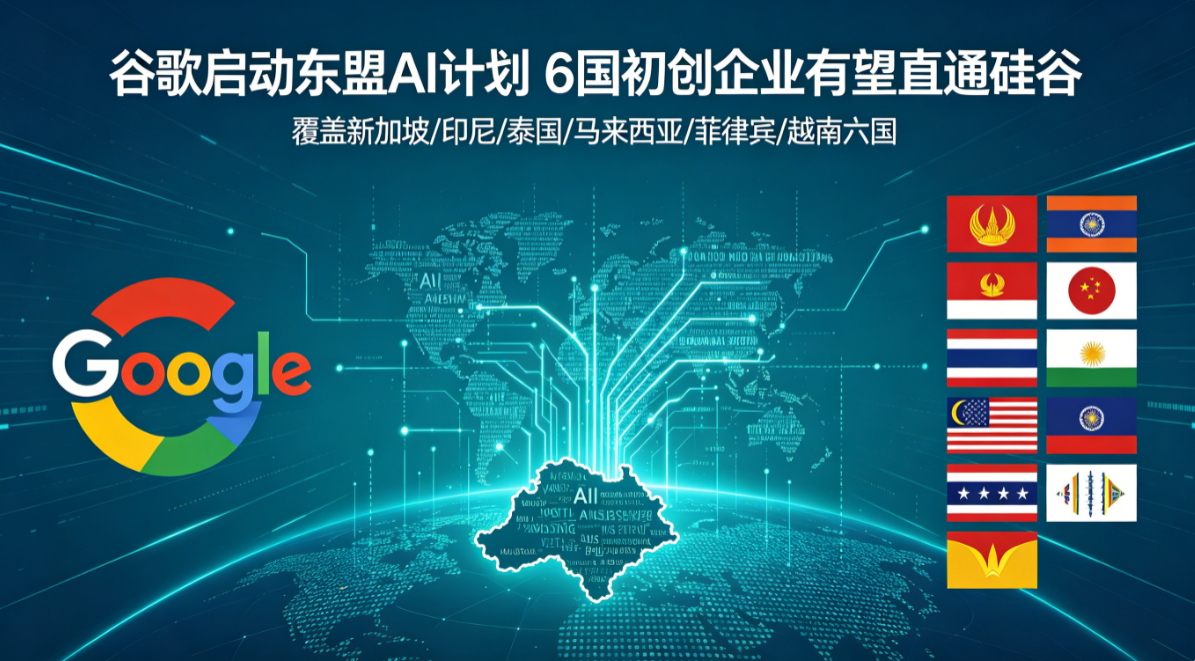
The 'AI Startup Innovation Corridor' is not a traditional startup accelerator. It is implemented through the 'Southeast Asia Google Accelerator' multinational incubation program, open to applications from six countries: Thailand, Singapore, Indonesia, Malaysia, the Philippines, and Vietnam, covering AI companies from early-stage to growth-stage. Google plans to select the first batch of 25 startups in August 2026. But unlike typical short-term mentoring lasting a few months, Google aims to build this into a long-term growth path.

This means selected companies will receive not only advice and training but also a complete tech ecosystem entry point. From early development to model training, deployment, and global expansion, Google hopes these companies will rely on its infrastructure from day one. Behind this deep-binding strategy is typical platform economy logic—when a startup's tech stack is deeply embedded in Google's ecosystem, its future expansion will only depend more on Google's cloud services, AI models, and tools.

Tech Empowerment: Deep AI Resources and Early Access

In terms of tech resources, Google showcases its strength as a global top AI company. Selected companies will access deep resources including AI-specific computing infrastructure (like TPU and GPU clusters), intelligent assistant development tools (like Dialogflow CX), and enterprise-grade AI development platform (like Vertex AI). More notably, companies can receive up to $350,000 (about 11.4 million Thai baht) in cloud service credits for AI model development, training, and actual deployment—a key boost to lower technical barriers for capital-limited startups.

However, perhaps the most strategic aspect is 'early access to new technology experiences.' Participating companies will have the opportunity to trial Google's next-generation AI models and tools not yet widely released, including the company's current key focus areas like intelligent assistant-related tech. This makes startups not just passive tech users but early testers and ecosystem co-creators. From a tech development perspective, the earlier a startup team accesses cutting-edge technology, the more likely they are to seize opportunities in future application scenarios. In return, Google gains real market feedback to accelerate tech iteration.

Global Bridge: Connecting Silicon Valley Ecosystem and Government Cooperation

Beyond tech resources, Google also tries to solve a core bottleneck for Southeast Asian startups: globalization. Many entrepreneurs, despite developing products that meet market needs, often struggle when stepping outside their local market. A key arrangement of the project is to let entrepreneurs stay and train in California, USA, directly accessing the Silicon Valley ecosystem, including visits to Google headquarters and top global VC hubs. This channel from Southeast Asia to Silicon Valley essentially helps regional AI startups cross the 'scaling chasm.'

Another noteworthy detail is the deep involvement of regional governments. Enterprise Singapore supports Singapore startups; Indonesia's Ministry of Communication and Digital Affairs, Vietnam's National Innovation Center, and Ho Chi Minh City Innovation and Entrepreneurship Center respectively promote their national AI ecosystem development. This reflects that ASEAN countries view AI as a key economic strategy—Indonesia hopes AI drives digital transformation in education, healthcare, and food security; Vietnam sees AI as key to boosting competitiveness in semiconductors, smart cities, and climate tech. Google's project thus becomes a model of public-private collaboration, with governments providing policy support and enterprise matching, and tech giants providing technology and global networks.

Ecosystem Effects and Global Competition Insights

Since 2018, Google's startup incubation projects in ASEAN have supported over 200 startups, with total financing reaching $6.6 billion and creating over 11,300 jobs. These numbers illustrate the cumulative effect of ecosystems—when enough startups grow on the same platform, network externalities create formidable competitive barriers. From a global competition perspective, Google's move is not only about nurturing startups but also competing with rivals like AWS and Microsoft Azure for infrastructure dominance in the Southeast Asian AI market.

Conclusion: Reshaping Regional Innovation Landscape with Tech Ecosystem

The deeper significance of the 'AI Startup Innovation Corridor' lies in showing how large tech companies can reshape regional innovation patterns from the ecosystem level. As AI models gradually commoditize, true competitive barriers will come from integration of data, application scenarios, and developer ecosystems. Google chooses to work in Southeast Asia, a market not yet fully carved up, through a trinity strategy of government cooperation, tech empowerment, and global connectivity, creating an ecosystem where startups are reliant on its infrastructure from birth. For ASEAN countries, this is both an opportunity and a challenge—how to embrace global technology while cultivating local tech autonomy will be a key issue in the AI race over the next decade.

Detail Page Advertisement
Article Details
Weibo